Direct action, Occupy Wallstreet, and the future of housing justice: an interview with Noam Chomsky
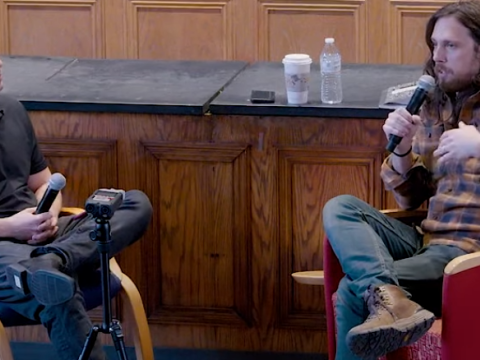
Check out this interview with Noam Chomsky about the growing housing justice movement, the future of Occupy, and how direct action can play into all of this.
As a commentator, educator, public intellectual, and one of the best-known anarchist voices in the U.S., Noam Chomsky has become a defining perspective as social movements develop. His analysis of the shift in global capitalism, and our own role in its flux, has seen a recharge of importance as we entered the “new normal” of the post-2008 economy.
Consuming lattes and labour, or working at Starbucks - Bryant Simon
An in depth portrait of what it is like to work at one of the most conspicuous components of the neoliberal order: the upscale looking, fast-food acting coffee chain, Starbucks. Simon discusses the emotional labors of being a happy and chatty “partner” (employee), the difficulties of the uneven scheduling, the unexpected physical aspects of the job, and the culture of conformity at the nation’s largest seller of coffee and affordable luxury.
The essay assesses the corporations’ reputation for being a good employer and contains extensive interviews with Wobblies trying to organize the chain. It suggests how workers are consumed by and with the brand in what the author calls “New Age welfare capitalism.”
International Labor and Working-Class History / Volume 74 / Issue 01 / September 2008, pp 193-211.
Women in the cleaning sector and hotel-restaurant industry: syndicalist conversations
The purpose of these interviews is to provide an insight into the situation and the struggles of female workers in the cleaning sector and the hotel-restaurant industry. To this end, we have met cleaning and catering trade union members of the CNT-Solidarité Ouvrière in the Paris region.
More generally, we hope to encourage readers to think about the relationships between women's struggles and labour unions, from the perspective of emancipatory social transformation. Of course, this article does not claim to exhaust the subject, but rather elicit contributions.
Greek anarchists on anarchist movement in Greece
Last weekend in the largest show of strength in over a decade thousands of anarchists marched to protest against the violent eviction of the squats of Villa Amalias and Skaramagka and Patision Sts in Athens and also the very repressive climate that police and state have created the last months in Greece.
Below is an interview with one of the largest anarchist groups in Greece- the Anti-Authoritarian Movement (AK) in relation to the present political and social climate in Greece, the threat posed by the far-right and of course the work of the anarchist movement.
Can you provide some background regarding the current crisis and austerity programme in Greece and how it is affecting the working class?
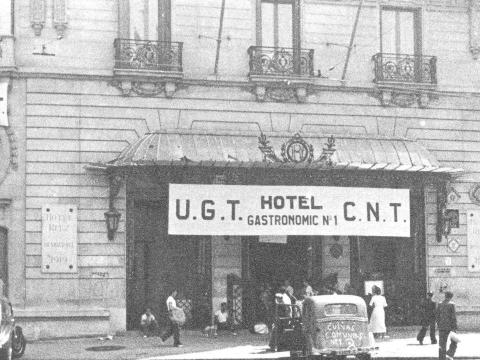
The CNT defense committees in Barcelona 1933-1938: An interview with Agustín Guillamón
A discussion of the rise and fall of the revolutionary institutions that were the foundation of the Spanish Revolution in the anarchosyndicalist stronghold of Barcelona, the social and organizational context of the anarchosyndicalist movement during the Civil War at the neighborhood level, the conflict between the rank and file militants and the collaborationist “superior committees” of the anarcho-syndicalist union the CNT, the meaning of the “spontaneity” of that movement and the process that led to its destruction at the hands of the republicans and Stalinists.
On the occasion of the 75th anniversary of the Spanish Revolution, our friend and collaborator Agustín Guillamón was interviewed by the editors of the website alasbarricadas.org about his latest book, Los Comités de Defensa de la CNT en Barcelona (1933-1938).
Alasbarricadas—An obligatory question: What were the Defense Committees?
The movements of the indignados and the class struggle - an interview with Charles Reeve
An interview with Charles Reeve, who discusses the workers’ struggles in contemporary China, the continuing relevance of Paul Mattick’s and Pierre Souyri’s analyses of the limits of state intervention with reference to the crises of neoliberalism and Keynesianism, and the significance of the movements of the Indignados and Occupy in relation to the decline of workers struggles in the developed world.
(Interviewed by Stéphane Julien and Marie Xaintrailles)
Could students in the US pull off a strike like in Montreal? An interview with Marianne Garneau
Against a kind of activist-y, spectacular politics, Marianne Garneau argues that US students and workers can learn from the Quebec model how to organize our power as a class. Quebec students have kept their tuition low because they’ve historically had a vibrant, militant student movement, one that is willing to strike and directly disrupt, and not wait for the leadership of the business unions. The organizing model is to create directly democratic bodies—department-by-department assemblies—that know how to leverage our power to fuck up the business of the people who are screwing us over, whether they’re our educators or our employers.
CW: Could you say a little about how you became involved in radical organizing, particularly around universities?
Conflict and repression in an Argentinean car factory: a cycle of resistance from a worker’s perspective
Maurizio Atzeni presents a worker’s account of two factory occupations in Argentina during the mid-1990s. This reconstruction, rather than focusing on the role of specific agents, allows an unveiling of the dynamics through which the clash between the employer’s drive for profitability and workers’ interests in defence of their salaries developed.
Stan Weir's oral history of the 1946 Oakland general strike
This is the transcription of a 1990 interview with Stan Weir for the Virtual Aural/Oral History Archive at California State University Long Beach (the audio is available here interview #3, section "3 of 9 items" ). In this segment Stan talks about his involvement in the 1946 Oakland General Strike.
Pat McAuley: What I meant to ask was: a lot of these short, wildcat-type strikes, like the sit-down strike that you led, did these contribute to the General Strike that occurred in 1946 or 1947 in Oakland?
[b]
Grassroots political militants: Banlieusards and politics
French cities burst back into flames after President Sarkozy’s election on a ‘clean the scum off the streets with a high-pressure hose’ ticket. It won't be the last time, as long as the factors necessitating the mass revolt of November 2005 remain in place, in France and elsewhere. This text, based on Emilio Quadrelli's interviews in the Paris banlieues during and after the 2005 events, overthrows the whole spectrum of slurs against the racialised, pathologised racaille. The myth of an all-boy riot is trashed by female combatant leaders, and leftist commonplaces incur special scorn, above all those about the inarticulate cry for help of the ‘socially excluded’.
Go home, white boy, we don’t need you[/i] – Henry Hampton and Steve Fayer, Voice of Freedom
Incipit. things and words*


Can comment on articles and discussions