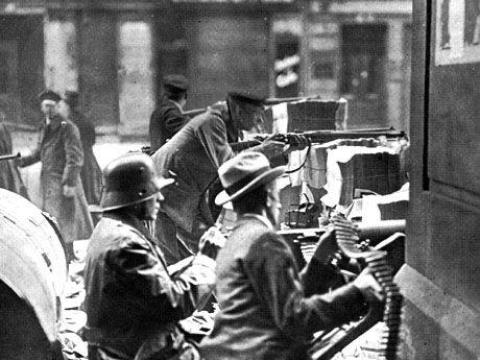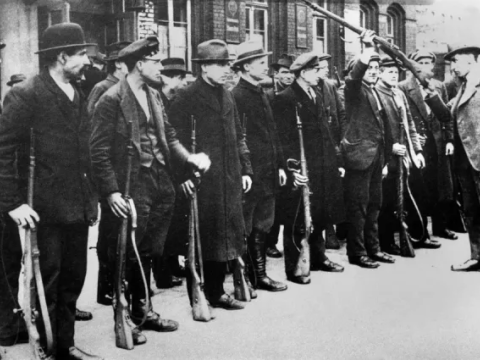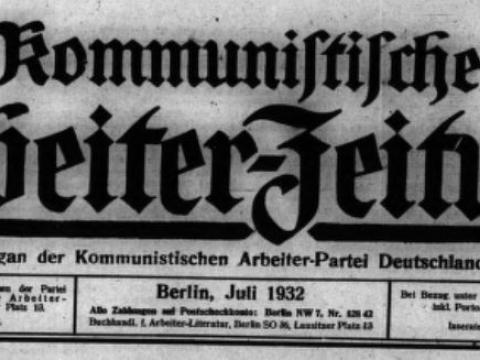
Kommunistische Arbeiter-Partei Deutschlands (Communist Workers Party of Germany), a councilist split from the Communist Party in 1920 who would be instrumental in defining the German-Dutch model of left communism.
Communist Workers' Party of Germany (Kommunistischen Arbeiter-Partei Deutschlands, KAPD), 1920-?
Founded in 1920, the KAPD was a left-wing, more radical council communist split from the German Communist Party (KPD). Members:Herman Gorter, Paul Mattick, Otto Ruhle
The KAPD’s Theses on the Party were written in July 1921 to be discussed not only in the party but within the Communist International.
1. It is the historical task of the proletarian revolution to bring the disposal of the wealth of the earth into the hands of the working masses, to put an end to the private ownership of the means of production, thus rendering impossible the existence of a separate, exploiting, ruling class.
A short biography of council communist and organiser of underground networks, Alexander Schwab, who died in a Nazi concentration camp.
Born on the 5th July 1887, at Stuttgart, Alexander Schwab was the son of a choir master. He studied at the Universities of Rostock, Jena, Heidelberg and Freiburg in philosophy, ancient languages, political economy and sociology. He was a member of the Free Students movement.
A short biography of council communist, organiser of underground network, Alfred Weiland, kidnapped by the East German state in the post war period
Alfred Weiland was born on 7th August 1906 in the Moabit district of Berlin. He apprenticed as a fitter. He later worked as a telegraph worker.
In 1925 he was for a short time a member of the Nazi Party (NSDAP) which in Berlin had a more “left” outlook than elsewhere. Soon after he joined the communist KAPD and AAU.
The Lessons of the “March Action”-Gorter’s Last Letter to Lenin
Dear Comrade Lenin:
When we last parted in November of 1920, your last words on our quite divergent ideas concerning revolutionary tactics in Western Europe were to the effect that neither your opinions nor mine had been sufficiently tested: that experience would soon prove which of the two is correct.
A look at workers' councils and the historical contexts in which they were created. A useful analysis - which challenges some aspects of the standard anarchist analysis of the events in Spain during the 1936 Revolution.
Tens of thousands of striking council workers disrupted public services across Scotland today while Scottish civil servants also struck for their own pay dispute.
An important document of Irish labour history, freely available online for the first time here, O'Casey's book tells the history of the formation of the Irish Citizen Army in 1913.
Howard Zinn's short history of the war in Vietnam from the beginning of the Communist insurgency in 1957 until the defeat of US and South Vietnamese forces in 1975.
First issue of an irregular workers' bulletin put together by users of the website, libcom.org. This issue focuses on the 2008 pay dispute over sub-inflation pay offers.